
"A tip from Lubitsch - Let the audience add up two plus two.
They'll love you forever." - Billy Wilder
Last week was looking at the potential of epistolary narrative - stories told through the format of letters, diaries and the like, rather than the perspective of characters in real time. There’s a lot to get through here, so I’m going to try to be as concise as possible.
This was, in part, an exercise in asking the wrong questions to get to the right answers. Or in this case, additional very spicy questions that lead to some very useful considerations. I’d initially seen the benefits of epistolary narrative as:
- Being able to focus on key moments in a story
- Allowing multiple voices and perspectives to tell the story
- Allowing foreshadowing and reflection to be included in the character’s voices as a part of the world
- Allowing world-building and unique perspectives via narrative told in “real world” artifacts - business correspondence and the like
Points 2-4 bore out under investigation. Point 1 was a swing and a miss, corrected during consults, but the consultations and readings teased out an underlying, more fundamental point (as Verbalize puts it)
In fiction, the secret to being imaginative is to unleash your audience's imaginations
To extrapolate, allowing enough room in a story for the audience to fill in gaps and build on what they are being told. To add 2 + 2, to take it back to the opening quote. This is how the audience builds investment and ownership over a story. This led to a second rule of dramatic writing being put forward:
Put effect before cause, and discover cause through the story
This is a mind-blowingly simple way of posing interesting questions to the audience through character. It suggests so many options so powerfully, and clarifies how to go about it. Create an interesting situation, determine the cause & effect, and show the effect first. Think of a path to unravel back to the cause. There’s another quote from Verbalize that reinforces this point from the perspective of audience buy-in:
The audience is much more likely to reach conclusions than accept them
Considerations Around Time
This leads into some interesting considerations around managing time. Epistolary narrative by its nature deals its narrative out in parcels of information. This appears to be a perfect form factor for a smart home device like Alexa, allowing for short sessions of play over time. Using a mechanism like Alexa’s notifications system, these parcels of story can be given out over time, adding to the illusion of the reality of the story world. An experience can become the player’s own serialised drama, forcing the player to wait for the resolution of cliffhangers and wonder at the fate of characters. I was particularly impressed when revisiting Three Minute Games Lifeline due to the tension that is introduced when the central character Taylor is investigating a sudden disturbance or a potentially ominous goal:
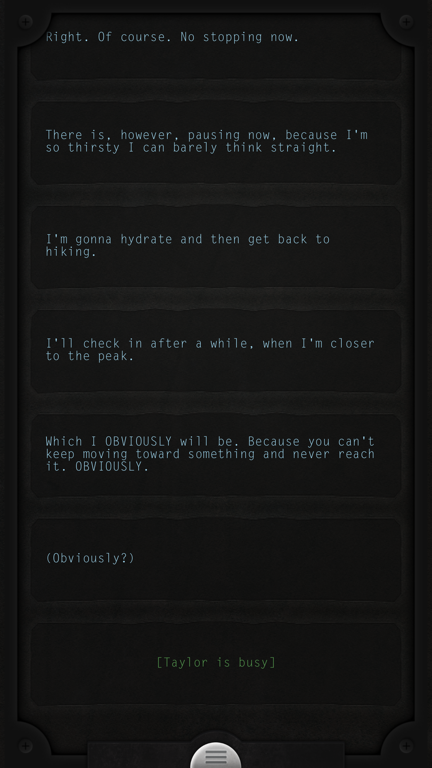
Time passing can enrich the experience, but it also brings some issues - chiefly, the player can forget specific information over time - plot, systems or character related, so some sort of recap mechanism allowing the user to easily revisit what they have learned over time needs to fill that gap. This presents particular challenges with an audio-only experience, as relying on listening to and recalling long lists of information isn’t really viable. This brings us nicely into:
Concerns Around Information Channels
One of the key concerns Alexander Swords raised preparing for our consults was considering using narrative design patterns to compare aspects of game types with the medium I’m working in. This led to a conversation about information channels and identifying the most appropriate for a piece of information. I’ve still got wrapping up external channels on my list of things to do, and I think this is part of why - it needs revisiting, which is what I’ll be doing this week.
The key point that came out of this was considering what the avialable narrative delivery systems are, and what their strengths and weaknesses are. As a basic summary, here are my starting considerations around available delivery systems:
| Channel | Strengths | Weaknesses |
|---|---|---|
| Voice |
Conveys aesthetic. Warm and relatable. Rich delivery of emotion and character. |
No ability to easily move through information and rescan & synthesize. Not good for complex information or multiple facts. Requires voice acting to be recorded. |
| Text To Speech |
Flexible - can be modified by modifying SSML. Does not require screen interface for attention. |
No ability to easily move through information and rescan & synthesize. Requires more effort from listener to parse and understand. Not good for complex information or multiple facts. |
|
Flexible - supports rich media and attachments. Ubiquitous contact method. Text format allows searching & rescanning of information. |
Player can get distracted by other important messages due to being returned to real world context. Unpleasant emotional context. Requires attention at screen. |
|
| Discord |
Highly configurable. Text format allows searching and rescanning of information. Rich delivery of emotion and character. Allows communication with Alexa skill state via Discord bot. |
Player can get distracted by other Discord notifications. Requires attention at screen. |
| Custom App |
Allows dynamic presentation of information based on player context. With the right narrative conceit, can *heighten* immersion. Allows interaction with skill via secondary interface. Can present elegant visualizations of complex information. (eg. heat map tables) |
Significant engineering effort. Requires screen attention. |
The key component of the information being delivered must be considered, as well as the tone and context of the information channel being used. For example, email is a straightforward communication mechanism that almost everyone has, but not one we readily associate with play - more likely unwanted demands on our attention, and a ‘work’ context. Whereas Discord may have a more informal, social context for a player.
The idea of creating a custom application to present information is an interesting one, too: the more complex the interface, the more the question becomes “Why make this an Alexa app?” rather than a web-based application open to a broader audience. There is a definite gravity that requires a justification to push back against. (one starting point that suggests itself here is the voice interface being much less ‘work’ for a player - a frictionless way of interacting with a complex experience)
Concerns Around What To Say
Art is the ability to remove unnecessary details
The final question raised over this week is what to tell, and what to leave hanging. What is necessary, and what is chaff? This is a question I imagine I’ll be grappling with for some time, but some excellent guidelines came out of the consults with Alexander. For starters, throughout the timeline of the narrative, consider:
- What does the player/protagonist know?
- What does the player/protagonist not know?
- What does the player/protagonist suspect?
- What misinformation has been given to the player/protagonist?
And consider what the impact would be of changing one or more of these.
Only tell the story you need to tell, and no more. While this might seem a little circular, it goes back to the central question that more and more underlies all the involved disciplines:
What is the story you want to tell, and what do you want the player to feel?
This takes us back to another cautionary rule - Don’t tell the player how to feel about things. It’s not a valid shortcut to engendering a feeling authentically.
Phew. That’s it from me for now. Hopefully that all made some sense.